Amjad Tawfiq and His Farm
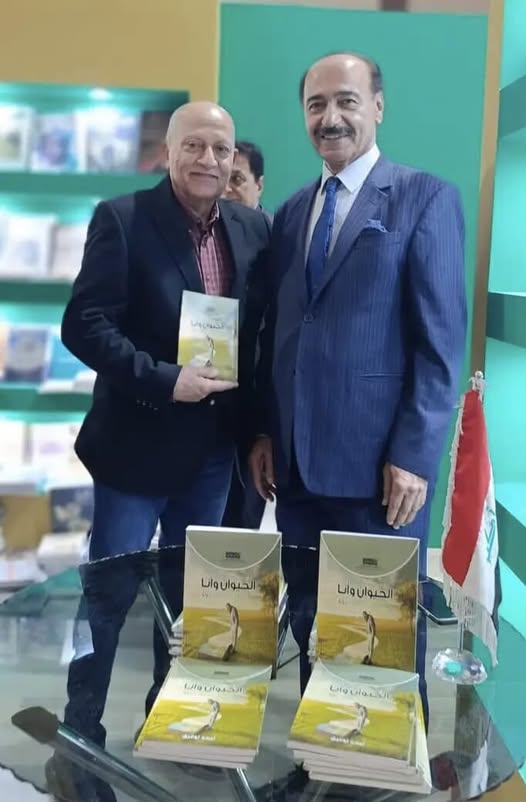
The book signing ceremony for the novel (The Animal and I) by the narrator Amjad Tawfiq — and the celebration of the novel and its author by the General House of Cultural Affairs at the Baghdad International Book Fair — was an opportunity to obtain a copy of the novel, the new creative work of my brother and friend Amjad Tawfiq.
The narrator Amjad Tawfiq has a creative journey encompassing many novels and stories, including: Mountain Childhood, Tower of Rain, The Long Shadows, The Golden Mistake, Snow Snow, Tara Castle, The White Mountain, his penultimate novel Yanel, and other works.
The novel (The Animal and I) continues the narrator’s creative trajectory, notable for its philosophical reflection, graceful style in formulating ideas, and distinctive language — key elements in achieving pleasure in his novels and stories. He is a sorcerer of language, granting it the power to attract the reader, providing both enjoyment and understanding, in addition to the questions he raises whose answers become new questions in search of a response.
Perhaps his questions are an attempt to distance himself from everything that drains him. He believes it is beneficial to live life in peace — no opinion is worth getting agitated over, not every word deserves a response. You cannot change the world around you, but you can reduce what disturbs your peace of mind.
Was this the orientation intended by the main character of the novel? The narrator Daniel Ali Musa, a retired army officer in his seventies, a widower who leaves his home and retreats to a farm he owns to find a space of rest, away from everything that disturbs his day:
I am preoccupied with my private life, trying to furnish the time of my day so it leaves no shadow I did not choose in my heart… I used to grant contemplation a value resembling the sparkle of a beautiful woman’s eyes that you love at a party — a glimmer only you can feel, and that is what gives it the radiance I claim.
I am not here practicing literary criticism of the novel — that is a craft for its own people. Rather, this is a simple reading of a novel that a reader like me cannot help but enjoy, appreciating the narrator’s abilities, the plot, and its characters. So I will try to point out the main lines of the novel and the questions it raises.
One of the questions: why did Daniel leave his home and the life, experience, and friends he was accustomed to, to retreat to a farm with nothing but animals — a horse, a dog, chickens, and cats? And why his focus on his relationship with the horse (Dhalam / Darkness) and the dog (Layl / Night)? Is it an indication of the qualities of loyalty and friendship free from premeditated motives that he seeks?
The reader finds that Daniel did not leave only his home, but also his acquaintances — except for a few (Abu Rami and four others). He sees that:
Nothing can affect the continuous support I receive from the farm and from my animal friends — no misplaced complaints, no incomprehensible desires, no psychological states difficult to understand.
But despite these justifications for seclusion, his daily suffering did not end because of his memory. And who among us can erase or replace their memory?
This weary memory confuses me, and I wish I could give it a long vacation. My happiness with Dhalam, Layl, my cats, chickens, and the trees of my farm would suffice… The problem is that what I wish to forget is stubbornly resistant to oblivion or disregard — it pursues me, and there is no way or plan to avoid it.
Here he is under the pressure of memory and a history of actions, situations, and experiences from which escape through the farm and cultivating friendships with animals seems but an attempt lacking all the tools for success.
Mawj — the daughter of his friend Abu Rami, a wealthy man in his fifties who owns large shops — her father was forced to take her to his friend Daniel’s farm after receiving a message from one of the gangs corroding the social fabric, demanding a large sum of money, threatening that if he refused or informed the police, his daughter Mawj would face kidnapping.
Mawj, in a letter to her father left where she was staying with her father’s friend, sees Daniel as a man outside the life that ought to be lived — perhaps his age and his loneliness after his wife’s death are two reasons for his condition.
But involving Daniel in the threat Abu Rami faced, and his daughter Mawj’s refuge at the farm, cut off Daniel’s ability to enjoy his solitude at the farm, away from the environment he had decided to leave in order to feel at peace with himself.
Daniel says describing Abu Rami’s state:
Abu Rami spoke, sad and in pain. During his speech, he recounted everything I know about the social collapse that followed the American occupation of Iraq.
Here is an indication of the most important reason that drove Daniel to seclusion and refuge in the farm: social collapse.
But it seems that Abu Rami brought Daniel back to the very milieu he had left for the farm — he had now become part of the threat his friend and his daughter faced:
Here is the city chasing me, me who fled from it… The sound of collapse knocks at my door as if to say: no use. Corruption, like termites, eats away at the heart and soul.
The matter of Mawj, in addition to visits from his few friends including Abu Rami, and the involvement of Dr. Nabil — Daniel’s son — in the threat against Mawj and her travel to London where Nabil resides, marked the beginning of Daniel’s return to his former environment. There was no opportunity for much longer to remain in retreat.
Add to this the entry of a new element into the farm’s world: Dhikra, whom Dr. Nabil provided the opportunity to live with his father Daniel at the farm due to social circumstances she had experienced, and to break the barrier of isolation surrounding his father.
All these factors — Abu Rami, the gang pursuing him and his daughter, the presence of a new woman in the farm’s days, and Daniel’s failure to neutralize his memory — pushed him to open a window to the course of life outside the farm, especially after he agreed to travel to London at Abu Rami’s insistence, to see his son Nabil and check on Mawj, followed by his son’s engagement to his friend’s daughter. As if a new world had begun to take shape in Daniel’s life.
The question: did narrator Amjad Tawfiq intend to say that recovery from the collapse that afflicted society after the American occupation is possible, as long as the damage does not control the conviction of people who believe in peace and hope for a better life?
The question Daniel poses in the last pages of the novel — What is the solution? — reveals much of the narrator’s vision:
There is no mistake unless you go looking for it. Then you can find mistakes, and your eyes will catch error in everything.. What is the solution? The last thing we should think of is passing judgment or forming a conviction. Rather, imagine yourself as a bridge — much foul or pure water passes beneath you, and many corrupt and pious, thieves and the poor, and thinkers pass over you.
Here, seclusion lost its ability to be a solution at the conclusion of this experiment: the farm.
A final note: the specter of death passes swiftly through the novel:
The animal inside me refuses to die in a way it did not choose.
But in the final lines of the novel, he makes a final confession that his goals have become like embers covered in ash — he wraps them on his way to killing them. He concludes the novel:
I am free. I am ready for death.
I say to my brother and friend, the creative narrator Amjad Tawfiq: you have created and presented a brilliant novel, adding to your great creative achievement.
sticker