Amjad Tawfiq and "Zaman al-Urjawan"
If you are afraid, do not take risks. And if you do take risks, do not be afraid. The gamble here is the search for a chance at life in a place caught between life and death, waiting to move forward — only to see, in the end, who shakes hands with devils and walks farther down the path to the abyss of disgrace. You find yourself facing a choice between truth and falsehood, between love and hatred, and sometimes between life and death itself. And the sum of these choices becomes your life.
Was this the state of Adam al-Furati, a journalist and writer at thirty-five, commanding a wide presence built on the seriousness of what he writes, confronting the politician Mas’ud al-Urjawan — a man of ambiguous life, full of positions and deeds no one can take pride in, accused of countless acts of corruption?
Certainly, the confrontation is not easy: a journalist who has nothing but his commitment to professional ethics in a negative atmosphere defined by a media that cannot distinguish between the function of information and the function of propaganda. And a politician who wants to use him as a tool for propaganda to cover up his shameful acts, his corruption, and his fabricated history.
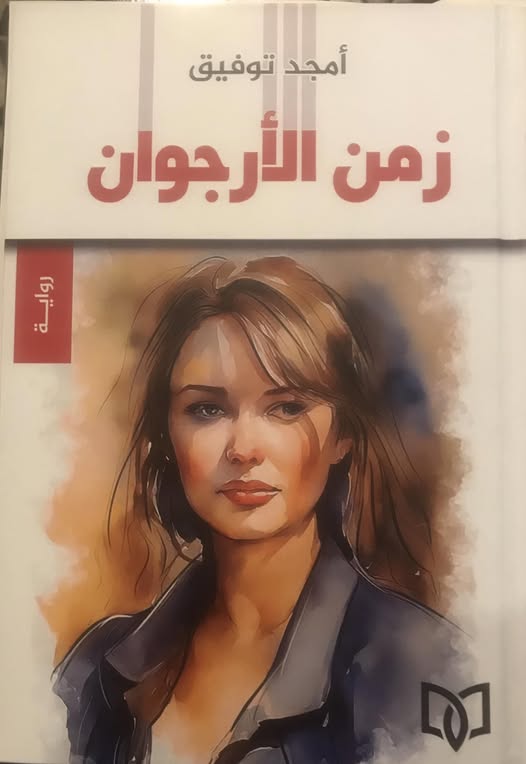
This is the difficult confrontation that the narrator Amjad Tawfiq places before us in his novel “Zaman al-Urjawan” (The Age of Purple), published by the General Union of Writers and Authors in Iraq, first edition 2024. The cover is adorned with artwork by artist Khaled Jallal, with design by artist Naseer Lazim. It follows 24 books in short story, novel, and criticism since 1974, and his creative output continues to glow, with a new short story collection awaiting publication.
At the outset of the novel, Amjad Tawfiq presents us with an important gateway that serves as a key to entering the story, revealing that the word only has its effect when it is heard or read. It is not a flower to be smelled or its beauty admired. Nor a river in which to seek the deepest point. Not a hard walnut shell to crack. Not a soft fruit to peel or squeeze. Nor poison to test its effect. It is all of these, and this is its secret and its magic — leading us to the conclusion: the truthful word is in a firm alliance with beauty and love.
Love, embodied in the novel through the relationship between journalist Adam al-Furati and television presenter Mayada, who becomes his partner in love and in confronting all the cunning and aggression of the politician al-Urjawan. The meeting of Adam and Mayada began at the request of al-Urjawan, who owned, among his assets, a television channel where Mayada worked. He tasked her with conducting a television interview with journalist Adam, in an attempt to extend his influence over the journalist, change his direction, and lure him into writing a book of memoirs to polish al-Urjawan’s ugly image.
But the journalist’s refusal of the television interview allowed Adam and Mayada to form a successful partnership against this corrupt octopus who does not hesitate to kidnap and kill those who expose his crimes and the falseness of his positions.
The meeting of Adam and Mayada happened by chance, and through the course of the novel we realize that some people we meet by chance or on a certain occasion leave a glow of love and beauty in our souls. We see the relationship between the two develop, ending in marriage at the close of the novel, after a series of difficult confrontations with al-Urjawan — beginning with the termination of Mayada’s work at his television channel, leading to the exposure of al-Urjawan’s role in the kidnapping and murder of a young protestor from Tahrir Square, and the attempt to assassinate journalist Adam after his kidnapping, and Mayada’s courageous role in his rescue.
The narrator Amjad Tawfiq takes us on an engaging and beautiful journey through the love story between Adam and Mayada. The novel presents many moments that express the legitimacy and courage of the journalist’s stance in confronting al-Urjawan — though he was not fearless; he knew that without fear, courage is incomplete. He also refuses to use the devil’s tools to do the Lord’s work. Thus we see him write on his computer:
In the global series of vice, neither religions were sufficient to curb the appetite of killers, nor did laws safeguard human freedom… And why are innocent efforts governed by the two elements of power and money?
The novel aims, among its objectives, to uncover the secrets of this last question. It presents a picture of what the October 2019 Tahrir protests suffered — murder, kidnappings, and enforced disappearances. It offers as a model the kidnapping of Saif, one of the activists in the protests, whose body was found a week after his abduction — behind which was al-Urjawan, whose false positions and corruption Saif had exposed.
In “Zaman al-Urjawan”, did the narrator Amjad Tawfiq intend to reinforce in our minds that:
- The wind cannot overcome trees with strong roots
- The word is a prisoner of the person who speaks it, and by uttering it they become bound by it
- We should not blame the snake for having fangs
- The ordinary path of life is easy, but no flowers ever grow on it?
“Zaman al-Urjawan” is an important novel worthy of reading — an exposure of everything ugly, evil, and aggressive that has afflicted our days, and an illumination of the path of love and beauty. It is an addition to the great creative journey of the narrator and friend Amjad Tawfiq.
Comments on the original post
Archived from the comments on the original Facebook post. Original post